REFLECTION On READINGS FOR THE FEAST OF ST. JOSEPH
God allows Joseph to face a contradiction which shakes the foundation of his being: his beloved Mary is found mysteriously pregnant. What has happened makes no sense and it must have broken his heart to the very core.
I think we are all familiar with contradictions and complications in life. If we are honest, I think we can admit there is always some real measure of contradiction and complication in our lives, and we can either become complicated ourselves or discover a way to transcend it.
Joseph overcomes complication through His own simplicity, specifically by his simple faith, infused with love. To choose to do only what it seems faithfulness demands, and to do so with love. To employ the best wisdom he can, in the most loving way he can. And then to release the decision to the Lord, and realize there is no more that can possibly be done, than to trust that any act made with faith and love will not be made in vain, but is sure to bear fruit.

We see something beautiful in God’s response to Joseph's decision that he will divorce Mary quietly. God intervenes and prevents Joseph from going forward at the last possible moment. It is just as it was for Abraham, saved from sacrificing his son Issac at the very last moment. Even if God stretches our faith to the extreme of waiting till the last possible moment of life, even then, it is so we will eventually see that faith prevails.
Let us look at the real contradiction and complication in our lives and ask ourselves: How can I respond with simple faith, infused with love? And then, entrusting our action to God, allow him to bear fruit in His time and way.
Author
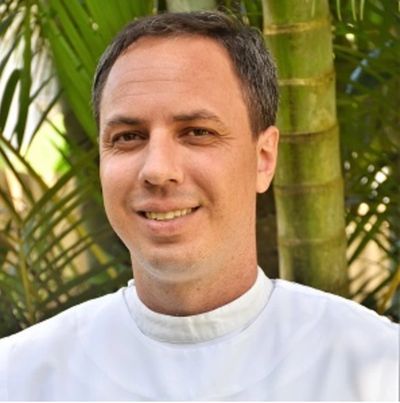
Fr. John is currently taking classes in Formation at the Chicago Theological Union in preparation for his becoming a socius or assistant to the novice master, Fr. Semisi Pulotu, ss.cc.
Fr. John Roche, SS.CC. / Ash Wednesday Reflection

Day of Atonement
Being smeared with ashes identifies us as a people with two certainties – we are a community of sinners and that will eventually turn to ash; including ourselves. In the ancient Israelite ritual of Yom Kippur (the Day of Atonement), as described in Leviticus 16, two goats played central roles — and their fates were strikingly different. The high priest would take both goats and cast lots over them. One goat was designated "for the Lord" and was sacrificed as a sin offering - its blood was sprinkled on the ark of the covenant to purify the sanctuary from the ritual impurity accumulated by the Israelites in the last year.
The second goat was designated "for Azazel(1)." The high priest would lay both hands on its head and confess over it all the sins, transgressions, and iniquities of the entire people of Israel, symbolically transferring those sins onto the animal. The goat was then led out into the wilderness by a priest and released, thereby carrying the people's sins away into a remote, uninhabited land.
This ritual symbolized the removal of the communities sins. The Israelites experienced God through the community and God in turn graced his People. Faith was very much communal. They were saved as the People of God.
A Penitential Period
Fast forward to the Christian era. Lent was regarded as the penitential period in the Church’s calendar – symbolized by the color purple(2). To celebrate this period the church reached back to the ancient days of putting on sackcloth and sprinkling their head with ashes as a sign they believed themselves to be sinners
before God and were asking for forgiveness.
Before 1200 AD, a person only entered the “penitential state” once in their life after their Baptism. For those who decided that this was the year to do it, they went to the priest and on Ash Wednesday the priest performed an “excommunication” ceremony over them, and they joined the ranks of the catechumens in sack cloth and ashes until Holy Thursday when they were received back into the Church – called the rite of reconciliation of penitents.
During this Lenten period - the priest met with them often and imposed many penances on them such as works of prayer, fasting, and almsgiving – sometimes very harsh penances were proscribed – i.e celibacy. Becoming a “penitent” was a rigorous thing to undertake.
"Anim Cara"
But then came along those Irish monks with frequent confession. The Irish Church was a monastic church and not a parochial church. In the Monastery the monks met frequently with their “Anim Cara” – soul friend to who they confessed frequently and little penances were imposed. They took this practice to Europe, and it caught on – much to the disdain of the European priests and bishops – in 1250 AD the Synod of Lyon denounced frequent confession as a “pernicious’ practice -- but it was popular with the people, and so it caught on.
The rise of private, repeatable penance gradually displaced the older public order of penitents. Confession became a regular, private sacrament, and the solemn public rite largely disappeared.

1972 Rite of Penance: 3 Forms
The 1972 Rite of Penance promulgated after the Second Vatican Council restored a sense of the communal dimension of reconciliation. It includes three forms:
Form One: Rite for Reconciliation of Individual Penitents
This is the ordinary, familiar form — private confession between one penitent and a priest. It has a richer structure than the pre-conciliar form, however, emphasizing scripture and dialogue. The rite ideally includes a greeting and blessing, a reading from scripture, confession of sins, a conversation with the priest, an act of penance (satisfaction), an act of contrition, absolution, and a proclamation of praise and dismissal. The intention was to make the sacrament feel less like a legal transaction and more like an encounter with the mercy of God.
Form Two: Rite for Reconciliation of Several Penitents with Individual Confession and Absolution
The community gathers, there are readings, a homily, an examination of conscience, and a general acknowledgment of sinfulness together — and then each person goes to a confessor individually before returning for a communal act of thanksgiving. It holds together the corporate dimension of sin and forgiveness with the personal integrity of individual confession. This form is particularly suited to Advent and Lent.
Form Three: Rite for Reconciliation of Several Penitents with General Confession and Absolution
General absolution is given to a group without prior individual confession. It is used where there is grave need and insufficient confessors, such as in mission territories or in danger of death.
The three forms together reflect the council's desire to recover the communal and scriptural dimensions of the sacrament while maintaining the essential structure of individual confession as the norm.
The whole tradition is a reminder that in the early church, sin and reconciliation were understood as deeply communal matters — not just transactions between an individual soul and God, but that sin affected the whole body of the church and not just the individual.
Since people no longer became “penitents” in Lent – everyone was smeared with the Ashes to remind the whole community that all are sinners and should amend their ways in preparation for the great celebration of Easter.
Bearers of the Ash
So, on Ash Wednesday the community of sinners becomes visible by the smearing of the Ash. The woman at the checkout, the man with the briefcase, the telephone repair man, the policeman, the nurse, children in the playground, the waitress… All bearers of the Ash. The smear of ash reminds us that through Christ we are all inter-connected and belong to something bigger – the People of God - and God sent his Son to save his People!
_____________________________
(1) From THIS we get the term SCAPEGOAT which entered English through William Tyndale's 1530AD Bible translation.
(2) Even though Advent and Lent are designated by the purple colour – they are different purples. Lent is a more blood tint purple and Advent is more bluish symbolizing more a sense of anticipation and hope rather than mortification.

ENTER INTO THE PASCHAL MYSTERY
BOOKS AND ARTICLES by Fr. Brian vincenzo Guerrini, ss.cc.

God and Life On The Pecos
God and Life On The Pecos
God and Life On The Pecos
This book explores finding God and life in the past, present and future along the Pecos River of southeastern New Mexico, a frontier region of the American West that earned a reputation for being wild, unexplored and rebellious (ala “there is no law west of the Pecos”) as it had been for thousands of years under Native-American, Spanish,
This book explores finding God and life in the past, present and future along the Pecos River of southeastern New Mexico, a frontier region of the American West that earned a reputation for being wild, unexplored and rebellious (ala “there is no law west of the Pecos”) as it had been for thousands of years under Native-American, Spanish, Mexican and American control. It is a book that gives the reader a glimpse into the lives and struggles of living in this part of the “Land of Enchantment” or “Satan’s Paradise” as the New Mexico Territory was labeled.
Available on Amazon, BN, Google Books
More Books
God and Life On The Pecos
God and Life On The Pecos
The French School of Spirituality of the 17th Century in the Charism of the SS.CC.
***
SS.CC. in the USA (1830-2025)
***
The SS.CC. Story on Molokai: Beyond the Leprosarium
***
The SS.CC. Missionary Story: Beyond France and Europe (1819 to the 21st Century)
***
The SS.CC. Story in California (1832 to the 21st Century)
Forthcoming Book
God and Life On The Pecos
Forthcoming Book
Among the Nations of the World: The SS.CC Global Presence, 1800-2025
***
Article
A Reflection: A Turnaround in Formation Philosophy: The Fiji Initiative Formation in the Unites States Province as a Source of Ongoing Formation
***
See ssccpicpus.com for books and articles by Fr. Brian, SS.CC.
Fr. John Roche, SS.CC. / Women, Sanctity and Sainthood

Women, Sanctity and Sainthood
Putting food on the table every day is an unenviable task. Trying to be creative on a daily basis makes one rack one’s brains. It is too easy to fall into the same-old, same-old routine week-in and week-out. The question: how do I make dinner interesting tonight? Is probably never considered by the rest of the family. Having cooked for others I know this dilemma – what on earth can I cook tonight? And you would love some input.
Media
So, you turn on the television and search for a cooking show hoping for inspiration. Personally, I love Jamie Oliver and his nonchalant approach to cooking. It is more like how my mother cooked – a cup of this and a pinch of that – she never had a kitchen weighing scale in her life – and yet she turned out some great feasts. Surprisingly, even though cooking meals tend to be carried out by women, the cooking shows are dominated by men!
Sanctity and Gender
Similarly, church services have a much larger female attendance than men. Something to do with women understanding the cross and the language of the cross better than men. Men are brought up with the hero model whose language is very different to that of sacrificial love. So, if women are so dominant in the church, how come there are so few women saints???
Women In the Early Church
The letters of Paul attest to the importance of women in the early church, and the gospels report how the female disciples supported the mission of Jesus financially. And talking of cooking – you don’t think the twelve boys cooked the last supper, do you?
Early Women Saints
One of the earliest records of a woman being martyred was Perpetua. Perpetua kept a prison diary and is one of the very few texts from the ancient world written by a woman in her own voice. She was a noble woman who refused to denounce the faith. She and her slave Felicity, who refused to abandon her, were both thrown to wild beasts and then beheaded. Even though this took place in Carthage they were both named in the early canon of the mass. Their feast is March 7th.
Following in their footsteps we have Agnes (Rome), Agatha (Sicily), Lucy (Syracuse), Cecilia (Rome - the church of Santa Cecilia in Trastevere in Rome is one of the oldest in the city), Blandina (Lyon in the Rhone Valley) – her memory is preserved in a letter from the church of Lyon to the churches of Asia. She was hung on a post in the arena and exposed to wild beasts. Blandina, too, was a slave; the lowest social status imaginable — whose courage surpassed everyone around her.

Cultural Influences
The theme of virginity and bodily integrity are common factors in their deaths. This gave women a particular kind of agency that their culture did not otherwise offer them. The martyr's arena became a space where social hierarchies were
inverted — slaves equal to nobles, women equal to men, the powerless triumphing over the powerful. And ever since the cause for sainthood for a woman has always been difficult if their virginity is not assured. Indeed, there was a big gap in making married women saints until Margaret of Scotland (1045-1093) and Elizabeth of Hungary (1207-1231).
The Israelites knew their heroes and heroines to be imperfect. The classic case is David who had Bethsheba’s husband killed in battle. Despite his faults they could see that the Lord was working through him. The Lord did not seek out perfect people to work for him – and still doesn’t. But somewhere in Christian piety it crept in that to be proclaimed a saint you had to be a perfect person.
The stories of these early women martyrs also show the church's instinct to celebrate women as full participants in the most demanding form of Christian witness. They were not auxiliary figures, but models for the whole church, and their names embedded in the oldest liturgical prayers, have kept their memory alive through the centuries.
Constantine’s Era
After Emperor Constantine's Edict of Milan in 313 AD, martyrdom ceased to be the
primary path to sanctity and new models emerged. Before Constantine various Roman Emperors persecuted the Church – i.e. St Peter was caught up in Nero’s purge of Christians. But most persecutions were sporadic. The Diocletian
persecution of 303-311 AD produced a great wave of martyrs across the empire, many of them women, most of them anonymous.
Early Women Saints
In the pre-Constantine church, there were a number of significant women:
Macrina the Elder, grandmother of Basil of Caesarea and Gregory of Nyssa. She is venerated as a confessor. Her granddaughter Macrina the Younger (c.327-379) was an even more significant figure — she founded a monastic community and was described by Gregory of Nyssa as a great theological teacher.
Monica (331-387), mother of Augustine, who was patient, persistent in prayer, and the model of the holy wife and mother.
Marcella of Rome (325-410) was a Roman noblewoman who turned her home on the Aventine into a centre of scriptural study. She was learned in Hebrew and the scriptures. She died from mistreatment during the Visigoth sack of Rome.
Paula (347-404) was another Roman noblewoman who founded monasteries at Bethlehem. She was learned, ascetic, and energetic, and Jerome's letters to and about her are among the most vivid portraits of a fourth century woman we possess.
Melania the Elder (c.341-410) and her granddaughter Melania the Younger (383-439) both gave away enormous fortunes to found monasteries and support the poor. Melania the Younger's story in particular is remarkable: she and her husband Pinian freed thousands of slaves, and eventually both entered religious life. She founded a monastery on the Mount of Olives.
The Ammas of the Desert – The Desert Mothers
In the pre-Constantine era women had major roles in the church. But when the Emperor made the church an official religion, there was a great influx of civic dignitaries and soldiers who frowned on women having these leading roles. So, women got the big elbow. A number of them disgruntled by this headed off to the desert to form their own communities – see Laura Swan’s book The Forgotten Desert Mothers(1). These desert communities produced many saints. Notable examples were Mary of Egypt (c.344-421) and Syncletica of Alexandria (c.270-350). Both had works that were widely read and survive in the Apophthegmata Patrum (The Sayings of the Desert Fathers). Syncletica was known as the female Antony.
Looking back over the first millennium, several things stand out. The martyrs dominate the first three centuries, then came the desert mothers, and after them came scholarly noblewomen, missionary abbesses, and holy queens.
The Anglo-Saxon period stands out for the number and quality of its women saints- i.e. Hilda of Whitby (614-680) who presided over the Synod of Whitby(2) 664 AD, which determined that the English church follow the Roman Rite(3).
______________________
(1) Laura Swan is a Benedictine prioress who has written on medieval women's spirituality — she also wrote on the desert mothers — and her approach tends to combine historical recovery with spiritual appropriation, drawing on medieval women's wisdom for contemporary readers.
(2) Yes, a woman presided over the Synod demonstrating the role women had in the early Church.
(3) England was evangelized by Irish Monks who first went to Iona and then founded a monastery at Lindisfarne and from there they started converting England. Being from Ireland the monks followed the Eastern rite as the faith came to Ireland from the East. Meanwhile the Pope sent Augustine to the South of England. They met inthe middle at Mercia. To standardize the faith the Synod of Whitby was called and elected to follow the Roman Rite.

The Second Millennium – the Age of the Mendicants(4)
Just prior to the turn of the millennium there was a great belief that the Lord would return in the year 1000. But he didn’t! And so folks began to wonder why. The answer was that we were too sinful – therefore, we needed to change and there was a great upsurge in piety. The decisive shift came when the reform movement captured the papacy itself. The turning point was the pontificate of Leo IX (1049-1054), a reforming bishop from Alsace who was appointed by the Emperor Henry III, but who immediately made the papacy the driving force of reform rather than its passive recipient. The reform reached its most dramatic and revolutionary
expression in the pontificate of Gregory VII (1073-1085) — the former Hildebrand, a Roman of obscure origin who had been the driving intellectual force of the reform movement for decades before becoming pope.
Against this upsurge in piety and reform background a new era in the church began with the founding of the mendicant orders. Now emerged the Franciscans, the Dominicans, the Servites, the Carmelites, and the Augustinians were the main foundations. And several women emerge from these Orders – most notably Clare of Assisi(5) and the Dominica Catherine of Siena(6).
By the twelfth century the church faced a serious crisis of credibility. The wealth of
monasteries and the corruption of much of the secular clergy stood in scandalous contrast to the gospel. At the same time rapid urbanization was creating new populations with a new middle class made up of merchants, artisans, students — whom the old parochial and monastic structures were ill-equipped to serve. Various movements arose to recover apostolic poverty and preaching. The preaching caused the most friction between the Mendicants and the ordained clergy who denounced it because they were not ordained and were jealous of the mendicants animated preaching. The Waldensians(7) were founded in Lyon 1170 AD to embrace poverty and preaching. Women were prominent in the early Waldensian movement —preaching alongside men, living the itinerant apostolic life (which the church frowned on). Eventually they were told they could only preach with the permission of the bishop. Unable to comply with this they were pushed out of the church(8).
Franciscan Preaching Controversy
Francis and his followers were not ordained but preached vigorously. At that time preaching was a clerical monopoly and it required episcopal authorization as it was understood to be an extension of the bishop's teaching authority. So, Francis went to Rome to see the Pope and in 1209AD Pope Innocent III gave permission for non-ordained to preach penance, a call to conversion, and encouragement in the faith but they could not comment on scripture (that is a homily) - that remained reserved to the clergy and this holds true to today.
Francis preached in Umbrian Italian — the vernacular of his region — which was itself significant. He also wrote in the vernacular, and his Canticle of the Sun is one of the earliest substantial literary works in Italian, a hymn of praise to God through the created order — Brother Sun, Sister Moon, Brother Wind, Sister Water — that expresses his theological vision with lyrical simplicity. It is a form of preaching through poetry.
Savonarola’s Piagnoni
Savonarola(9) attracted an extraordinarily fervent female following. Women of all social classes; from noblewomen to servants. They flocked to his sermons at the cathedral of Santa Maria del Fiore. His preaching offered a powerful spiritual experience and a sense of genuine religious seriousness at a time when much of the church felt corrupt and hollow.
His followers were called the Piagnoni or"snivellers” a mocking name given by his opponents that referred to the weeping his sermons provoked. Women were prominent among them, and some became intense propagandists for his cause within their households and social networks.
Savonarola's reform program had direct implications for women's lives. He preached against vanity, luxury, and immodest dress with great vehemence. His followers went through Florence collecting mirrors, cosmetics, fine clothes, wigs, and other "vanities" for the famous Bonfires of the Vanities 1497-1498 AD(10).
Savonarola had deep connections with Florentine convents and took a serious interest in female religious life. He corresponded with nuns, directed their spiritual lives, and saw the reform of convent life as integral to his broader program.
However, he attacked the Pope Alexander VI (the infamous Borgia Pope and widely regarded as the most corrupt pope ever) and Rome was very hostile to him and organized his demise. They accused him of heresy, schism and sedition. They arrested, tortured and executed him by burning.
______________________
(4)The first 1000 years of the church was dominated by the Monastery – they were mainly in isolated places. The Mendicants brought the Monasteries into the towns and developed pastoral ministries within the town.
(5)Other notable Franciscans - Angela of Foligno, Margaret of Cortona, Agnes of Prague and Umiliana dei Cerchi.
(6)Other notable Dominicans - Mechtild of Magdeburg, Gertrude the Great, and Mechtild of Hackeborn.
(7)They saw themselves as a reform movement within the Church.
(8)They maintained a strong following and in 1532 they allied themselves with the Reformers.
(9)The Medici had been expelled in 1494 AD and Florence had become, under his influence - He had reorganized the city's institutions, reformed its approach to taxation and poor relief, and created a remarkable atmosphere of public religiosity. He organized the youth of Florence into a kind of religious militia, going through the city in processions, singing lauds, and collecting alms.
(10)The first great Bonfire took place on Shrove Tuesday 1497 AD — the last day of carnival, the traditional season of license — and a second followed on Shrove Tuesday 1498 AD. The Bonfire itself was a carefully choreographed spectacle. In the Piazza della Signoria — the great civic heart of Florence — an enormous pyramidal structure was built, each containing different categories of objects. The pyramid was constructed with deliberate symbolism — the least offensive objects at the base rising to the most serious at the top.

The Beguines
The Beguines (pronounce bee-goynes) began to form in various parts of Europe in the 1200s. Beguines were laywomen, not nuns, from all walks of life and they did not live in monasteries. They practiced a remarkable way of living independently, and they were never a religious order or a formalized movement. The movement gave women ownership of their spiritual development and expression, a
considerable level of economic and social independence, and a passionately expressed sense of community and purpose. One of their distinctive spiritual practices was praying for thedead. They were really committed to this and fervently prayed for the dead every day.
There were common elements that these medieval women shared across Europe, including their visionary spirituality, their unusual business acumen, and their courageous commitment to the poor and sick coupled with their embrace of poverty– influenced by the life of St Francis of Assisi. Beguines were essentially self-defined, in opposition to the many attempts to control and define them. They lived by themselves or in communities called beguinages, which could be a single home for just a few women or, as in Brugge, Brussels, and Amsterdam, walled-in rows of houses where hundreds of beguines lived together - a village of women within a medieval town or city.
Swan(11) devotes significant attention to the four great mystical writers the movement produced. Among the beguines were celebrated spiritual writers and mystics including Mechthild of Magdeburg, Beatrijs of Nazareth, Hadewijch, and Marguerite Porete (The Mirror of Simple Souls). Swan believes that the most important legacy of the beguines is their bold vision for the possibilities of community — intentional communities committed to working for and with the marginalized and carried by a love for beauty and creation. Remarkably, beguines have existed in regionally distinctive ways from the thirteenth century to the present day — even before the death of the last beguine, Marcelle Patten, who died in Bruges in 2013, young women across Europe had become beguines, living alone and in small informal groups.
Post Reformation
The Council of Trent generated the Counter reformation agenda of propping up the “catholic” way. Onto the stage steps two women – Catherine of Siena (a Dominican tertiary) and Teresa of Avila (a Carmelite nun). Catherine provided a model for lay women and Teresa the more ideal model for women – a cloistered and contemplative life. Until Vatican II (and it still lingers in clerical circles) the religious life was seen as a higher calling than married life. The Council of Trent and the Catholic Reformation brought significant changes to this world. The institutional church became more cautious about the spirituality of women and more insistent on enclosure, and more control. Several of the women who had
been celebrated in the fifteenth century found their causes for canonization
stalled in the post-Tridentine church as it applied more rigorous and skeptical criteria to claims of sanctity.
Catherine(12) was steeped in the Italian Spirituality of the Sante Vita(13). They were lay people who became tertiary(14) members (third order) of mendicant orders. For women the third order offered something invaluable in that it gave a recognized religious identity that did not require entering a convent, taking solemn vows, or abandoning the world. The list of significant tertiaries is remarkable. Catherine of Siena and Rose of Lima among the Dominicans. Francis himself created the Franciscan Third Order and figures like Angela of Foligno, Margaret of Cortona, and Elizabeth of Hungary are associated with it. Thomas More is sometimes cited as a Franciscan tertiary. In the modern period figures as varied as Dorothy Day.
The Sante Vita movement flourished in northern Italy from roughly
the mid-fifteenth century through the early sixteenth. The observers of the
Sante Vita called for strict adherence to the original rules of the mendicant
founders and they dedicated themselves to strict lives of prayer, extreme
fasting, and physical suffering as a means of gaining spiritual intimacy
with Christ. Their motivation - the Imitatio Christi (the imitation of Christ)
was central and was taken to extraordinary physical extremes. These
women sought to participate in Christ's passion through their own bodies
by fasting, sometimes to the point of surviving on the Eucharist alone,
through the images of the passion, through illness accepted as participation
in Christ's suffering. The body(15) became the primary site of spiritual
experience and witness.
Teresa of Avila(16) inherited a rich tradition of female mysticism and sanctity of the previous century, such as the Dominican tertiaries and the Rhineland mystics. But she also inherited the deep institutional ambivalence that had always accompanied that tradition. The church had never been entirely comfortable with women who claimed direct experiential access to God. The fundamental tension was structural — women lacked the theological education and the ordained authority that gave men's religious experiences institutional legitimacy. A woman who claimed visions, locutions, or mystical union was making an implicitly large claim about her own spiritual authority, and the church's instinct was always to subject such claims to rigorous scrutiny, and in Spain there was the Inquisition. So Teresa had to be careful how she wrote.
The Council of Trent, which ran from 1545 to 1563 AD and whose reforms were being implemented throughout much of Teresa's adult life, significantly altered the institutional landscape for women's sanctity.
Enclosure was dramatically tightened. The decree Periculoso of 1298 AD had long required nuns to remain enclosed, but it had been widely ignored or circumvented. Trent re-imposed it with new seriousness, and the subsequent bull Circa pastoralis of 1566 AD under Pius V extended strict enclosure to all women religious, including tertiaries living in community. This was a direct assault on the model of active, world-engaged female sanctity that the Sante Vita had represented.
The Role of Male Confessors and Spiritual Directors
One of the church's primary mechanisms for managing female sanctity was the institution of the male spiritual director or confessor. A woman's religious experiences were legitimate only insofar as they were submitted to male clerical scrutiny. The confessor functioned as a kind of gatekeeper — he could validate or invalidate her experiences, permit or forbid their expression, and take responsibility for their orthodoxy before the institutional church. This created complex relationships of power and dependency. Teresa's relationships with her various confessors and spiritual directors — some supportive, some hostile, some well-meaning, but poorly equipped to understand what she was describing. Her early director Francis of Borja and later John of Avila were crucial in validating her experiences. Peter of Alcantara, the austere Franciscan reformer, became one of her most important advocates. But she also encountered directors who told her she was being deceived by the devil, who forbade her to practice interior prayer, and who treated her experiences with suspicion or contempt.
The question of women writing about their own spiritual experiences was itself fraught. Teresa wrote under obedience — commanded to write by her confessors — which gave her a kind of legitimation, but also meant that her writing was always in some sense accountable to male authority. Her work, Life, was submitted to the Inquisition after her death. The Interior Castle and The Way of Perfection were examined during her lifetime. The Life was retained by the Inquisition for years. The Inquisitor General Valdés had placed works by Luis de Granada and other spiritual writers on the Index in 1559 AD, and the climate of suspicion around vernacular mystical literature was intense.
___________________________
(11) The Wisdom of the Beguines: The Forgotten Story of a Medieval Women's Movement.
(12) Beside Catherine the four best-known Italian holy women of the period were Lucia Brocadelli, Colomba.
Guadagnoli, Stefana Quinzani, and Osanna Andreasi.
(13) Gabriella Zarri — Living Saints: Court Prophecy and Female Devotion between the 1400s and 1500s, 1990 AD.
(14) A tertiary is a lay person who is affiliated with a religious order and shares in its spiritual life and charism without being a full member of the order.
(15) Caroline Walker Bynum in her influential study Holy Feast and Holy Fast explored how food and fasting functioned in medieval women's spirituality as a form of power and control, a way of accessing the sacred through the body.
(16)There is a catalogue of Spanish holy women to be found on HTTP://visionarias.es/en

The Post-Tridentine Church 1600 on
The seventeenth century saw an extraordinary proliferation of female sanctity in
the Catholic world that pitted itself against the institutionalization of Rome. A case in point is Mary Ward:
Mary Ward (1585-1645) is one of the most significant and in some ways a tragic figures of her time. An English Catholic who had fled persecution, she founded the Institute of the Blessed Virgin Mary (Loretto) - a community of women who would live without enclosure, work in education and apostolic ministry, and be governed by a woman superior general based on the Jesuit model. The institutional church crushed her. Her institute was suppressed; she was briefly imprisoned by the Inquisition and declared a heretic — a charge later withdrawn — and she died without seeing her vision vindicated. Her institute was eventually reconstituted(17)
after her death, and she was beatified in 2009. Her story captures perfectly the tension between the post-Tridentine insistence on enclosure and the apostolic energy of women who refused to be confined by it.
The new model of religious life founded by Ignatius of Loyola open the way for women to reassert themselves in the Vita Ecclessia – life of the Church. His model was for small communities dedicated to a particular pastoral need. And so modern religious life blossomed again for women and we now have too many female saints to list here.
Modern Day Recognition of the role of Women
The declaration of women as Doctors of the Church — Teresa of Avila and Catherine of Siena in 1970, Thérèse of Lisieux in 1997, Hildegard of Bingen in 2012 - represents a significant, if not very late, acknowledgment that women's theological insight is of universal authority for the whole church. That it took until 1970 for any woman to receive that recognition, and that only four have received it compared to thirty-three men, measures both the distance the church has travelled and the distance that remains for it to go.
No doubt you will say I never mentioned n……. True! I wanted to give you a flavour of the role of women in the church and in this selecting holy women you might not have heard of. A great debt is owed to these women who persisted despite all the effort to suppress them.
_________________________
(17)One member everyone knows – Mother Teresa of Calcutta. She did her novitiate in Dublin, then sent to Calcutta. She was a member of the Loretto in Entally, Calcutta. Eventually she left the Loretto convent to start her work in the house of the dying in Kalighat, Calcutta.
About the Author
Father John Roche, SS.CC. resides at the Damien Residence in La Verne, California.